


With the CLAT 2027 exam date set for 6 December 2026, the final stretch of 50 days requires a decisive pivot. Transitioning from theory-heavy learning to an intensive mock-testing routine is essential for securing admission into the 26 NLUs. At Surya Law Academy in Sector 25-D, Chandigarh, where our mentors have guided aspirants since 2012, we advise shifting to a disciplined three-mocks-per-week cadence. Here is how to structure testing and post-test review for steady CLAT score improvement.
💡 Simulate the exact 2:00 PM to 4:00 PM offline exam slot thrice weekly on OMR sheets, dedicating four hours of post-test analysis to every two-hour test you complete.
The Ideal Mock Cadence: Why Three Tests Per Week Works
With roughly seven weeks remaining until CLAT 2027 on 6 December 2026, transitioning from concept learning to mock evaluation is crucial. Many aspirants make the mistake of attempting a mock daily, leading to severe cognitive fatigue. A rhythm of three mocks per week provides an optimal balance between test simulation and error resolution.
This schedule allows you to alternate high-intensity testing days with dedicated repair days:
Take full-length offline mocks on Tuesday, Thursday, and Sunday.
Reserve Monday, Wednesday, and Friday for granular question diagnosis and targeted drills.
Use Saturday for current affairs revision and consolidation.
At Surya Law Academy in Chandigarh, our classroom batches of 15-25 students utilize this cadence to secure predictable score leaps without late-stage burnout.
Synchronizing with the 2:00 PM to 4:00 PM Exam Window
The Consortium of National Law Universities conducts the CLAT exam from 2:00 PM to 4:00 PM. Practicing outside this schedule disrupts your biological focus. The human brain operates on circadian rhythms, and afternoon sluggishness can derail your performance if you are accustomed to studying only late at night.
To build peak alertness during the exact test hours:
Sit at a formal study desk without refreshments between 2:00 PM and 4:00 PM.
Print the test and use an authentic OMR sheet with a black or blue ballpoint pen.
Treat every practice run as non-negotiable by eliminating digital distractions.
Because CLAT remains a 100% passage-based offline paper with 120 questions, bubbling technique and physical pacing directly prevent lost marks under real exam pressure.
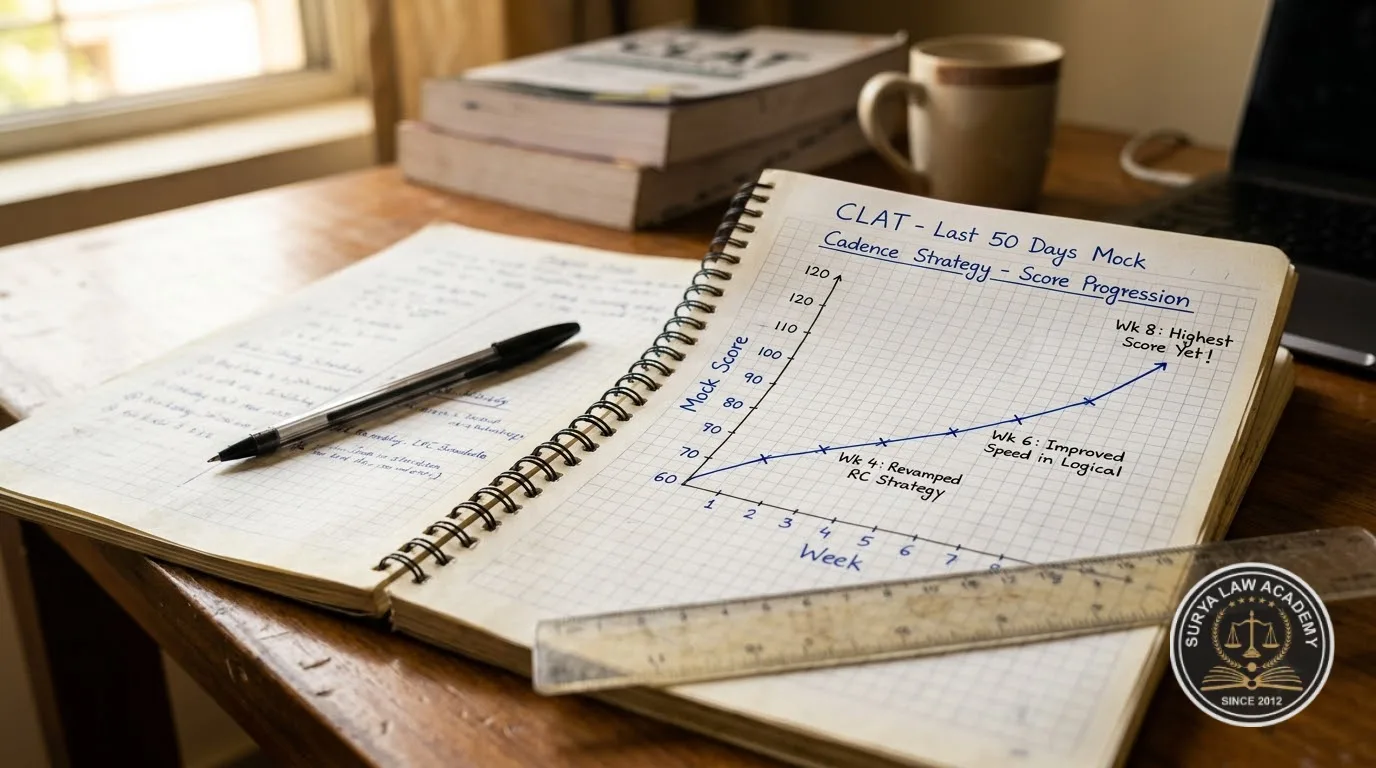
The Diagnostic Rule for Real CLAT Score Improvement
Taking a test without deep analysis is wasted effort. For every two-hour mock, allocate at least four hours to post-test diagnostic review. A thorough analysis reveals whether lost marks resulted from comprehension lapses, rushing, or poor question selection.
Structure your mock analysis across three specific categories:
Conceptual errors: passages where legal reasoning or logical assumptions were misunderstood.
Calculation slips: avoidable errors in the Quantitative Techniques section.
Negative marks: incorrect guesses that incurred the -0.25 penalty per wrong answer.
Track these trends in an error logbook. Our past classroom achievers, such as Saransh Kumar (CLAT AIR 25) and Ananya Sharma (CLAT AIR 32), prioritized eliminating recurring errors over merely accumulating high mock counts.
Balancing Current Affairs and Quantitative Techniques
The CLAT syllabus demands steady preparation across all five sections. Current Affairs, including General Knowledge, accounts for 28-32 questions, while Quantitative Techniques contributes 10-14 questions. Ignoring math or cramming current affairs in the final week is a common pitfall.
To balance these sections effectively during the 50-day window:
Revise current affairs events spanning roughly the last 18 months before the test.
Practice at least two passage-based Quantitative Techniques sets daily.
Solve sectional tests for Legal Reasoning (28-32 questions) to refine your reading speed.
With 120 marks at stake across 120 questions, consistent scoring in Quantitative Techniques often distinguishes students qualifying for top institutions among the 26 NLUs.
Fatigue Management and Sustaining Mental Stamina
The final 50 days bring considerable psychological pressure, making fatigue management as vital as academic preparation. Diminishing returns occur when students take mocks back-to-back without mental recovery. Sustained stamina requires deliberate pacing.
Incorporate practical routines to protect your mental focus:
Maintain consistent sleep patterns, particularly avoiding late-night cramming.
Break prolonged study blocks with short physical walks and screen-free intervals.
Seek direct mentor guidance whenever scores hit an apparent plateau.
Surya Law Academy brings 14 years of mentoring experience since 2012, backed by 820 Google reviews at 4.9 stars. Our faculty, holding qualifications including Gold-Medalist B.A. LL.B, LL.M from Panjab University, and UGC NET Law, ensures students navigate this intensive period with calm, methodical confidence.
🎯 Sharpen Your GK Right Now
Practice today's 10-question CLAT / PU Law daily current-affairs quiz with instant scoring and a live leaderboard.
📚 Download the Free 50-Day Countdown Prep Sheet
Get a free, printable one-page revision sheet sent straight to your WhatsApp. No spam, only study material.
🔒 100% private. Only study material — no spam calls.
Plan Your CLAT Strategy Preparation With an Expert
Join the batch that produced CLAT AIR 17 (NLSIU), AIR 32 (NLSIU) and PU UILS AIR 1 & 4. Small batches, direct mentor access, 200+ mocks.