


Welcome to Surya Law Academy! Stepping into the world of law entrance exams can feel overwhelming, especially when you encounter dense legal passages in CLAT. Many aspirants worry that they need to memorize sections of the Indian Penal Code or the Constitution before attempting the exam. The truth is, CLAT tests your reading comprehension and analytical application, not your memory of bare acts. With 14 years of mentoring aspirants since 2012, we have seen thousands of students transform their legal reasoning scores from 22 to 30+ using systematic practice.
💡 Never apply your personal sense of justice or outside legal knowledge; always treat the printed principle in the passage as absolute law.
Understanding the CLAT Legal Reasoning Pattern
The CLAT exam features 120 MCQs in a 2-hour offline OMR format, where the legal reasoning section consists of roughly 28 to 32 questions divided into multiple passage-based sets. Each passage introduces a legal principle—sometimes a real statutory rule, sometimes a hypothetical one—followed by a set of factual situations.
Every question requires you to deduce how the stated principle applies to the new facts.
The Consortium of National Law Universities designed this format to test analytical reasoning rather than rote memorization.
Because there is a negative marking of -0.25 per wrong answer, guessing blindly can hurt your overall merit score severely.
The Principle-Fact Matching Method
The core technique for solving legal reasoning passages without a law background is the principle-fact matching method. Read the principle carefully and break it down into its essential ingredients or conditions. Then, examine the factual matrix to see which conditions are satisfied.
If a principle requires 'intentional misrepresentation' and 'subsequent financial loss', look specifically for evidence of both elements in the fact situation.
Distinguish clearly between the core rule and any illustrative exceptions mentioned in the text.
Avoid bringing outside knowledge of laws into the exam hall; if the passage states a rule that contradicts real-world legislation, the passage's rule is the only one that applies for that question.
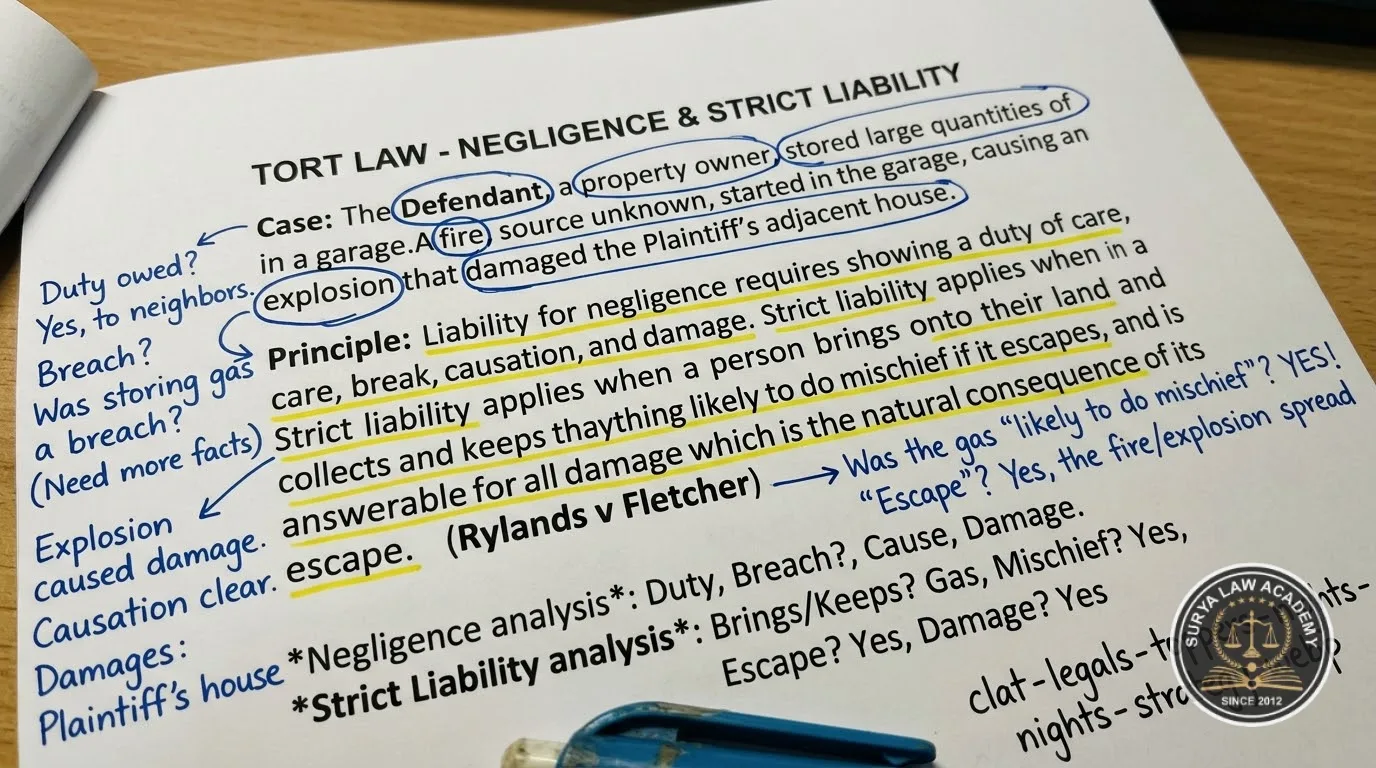
Why 'Most Logical' Beats 'Most Fair'
A common trap for beginners is choosing an option that feels morally fair or socially equitable rather than logically sound. The CLAT legal reasoning section rewards strict logical deduction over emotional or humanitarian responses.
Ask yourself what follows logically from the principle, not what outcome would make everyone happy in a real courtroom.
If the principle dictates liability under strict liability rules, do not look for negligence just because it feels fairer to do so.
Train your mind to detach from personal opinions when evaluating options so you consistently pick the answer supported directly by the text.
Passage Speed Tips and Time Management
With 120 questions to solve in 120 minutes, time management is just as crucial as conceptual clarity. Reading lengthy passages requires active engagement rather than passive scanning.
Skim the questions briefly before reading the passage so you know what specific details to look out for.
Underline key terms and conditional words like 'unless', 'provided that', 'only if', and 'shall' while reading the principle.
Maintain a steady pace to ensure you complete all legal reasoning sets without rushing through the quantitative or logical sections at the end.
Scaling Up Your Daily Drill Volume
Moving your score from the low twenties into the thirties requires consistent, structured practice and comprehensive test-taking.
Practice regularly using high-quality mock tests and hardcopy study material designed for serious aspirants.
Analyze every single incorrect answer in your mocks to identify whether the error stemmed from misreading the principle, over-applying outside knowledge, or falling for a distractor.
Surround yourself with a focused peer group; at Surya Law Academy, our batch sizes of 15-25 students per batch ensure personalized attention and rigorous daily doubt resolution.
🎯 Sharpen Your GK Right Now
Practice today's 10-question CLAT / PU Law daily current-affairs quiz with instant scoring and a live leaderboard.
📚 Download the Free Legal Reasoning Prep Sheet
Get a free, printable one-page revision sheet sent straight to your WhatsApp. No spam, only study material.
🔒 100% private. Only study material — no spam calls.
Plan Your CLAT Strategy Preparation With an Expert
Join the batch that produced CLAT AIR 17 (NLSIU), AIR 32 (NLSIU) and PU UILS AIR 1 & 4. Small batches, direct mentor access, 200+ mocks.