


In the pressure of the 120-minute CLAT examination, candidates often feel compelled to mark every bubble on the offline OMR sheet. However, reckless guessing is the single fastest way to destroy your national ranking. Since 2012, Surya Law Academy has mentored aspirants in Sector 25-D, Chandigarh, guiding students toward top NLUs. Understanding when to leave a question untouched is just as critical as knowing the right legal reasoning or reading comprehension answer.
💡 Every four wrong answers completely wipe out one correct mark. Only take calculated risks when you have decisively eliminated multiple choices from the passage-based question.
The Mathematical Reality of the Minus 0.25 Penalty
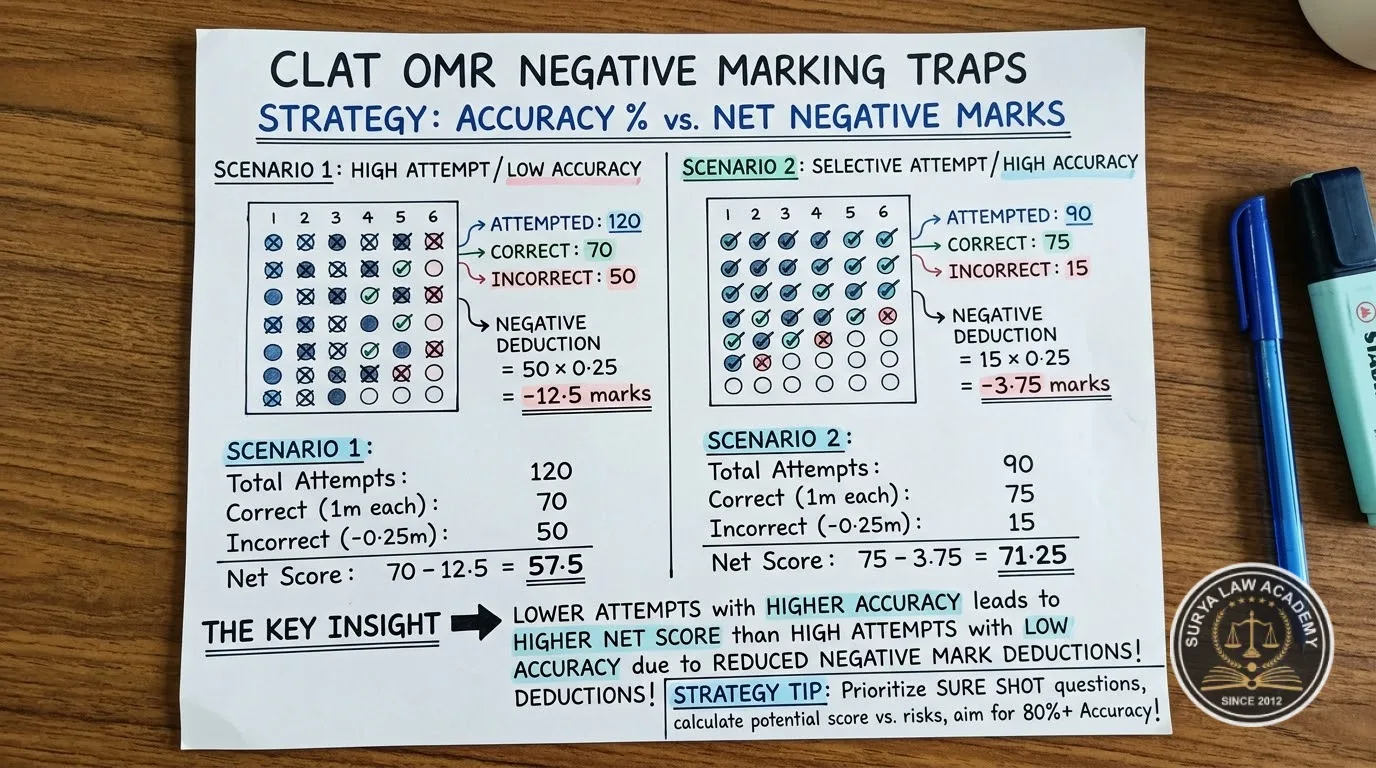
The CLAT test structure awards 1 mark for each correct answer and imposes a penalty of -0.25 marks for every incorrect answer across its 120 MCQs. Many students mistakenly assume that a minor penalty carries negligible weight, but the cumulative effect can rapidly erode your total score.
When you make four blind guesses and get all four wrong, you lose an entire mark that you worked hard to secure elsewhere. In competitive national admissions where fractions of a mark determine entry into top NLUs, unforced errors push candidates down hundreds of ranks.
One correct response awards plus 1 mark.
Four incorrect attempts subtract 1 full mark.
An unattempted question results in zero loss and preserves your hard-earned baseline.
CLAT Elimination Technique: Replacing Luck with Logic
Blind guesswork relies solely on arbitrary hunches, which often backfires under exam stress. Conversely, an intelligent elimination strategy draws direct evidence from the provided comprehension passages.
To master this approach, train yourself to filter out clearly flawed options before considering a response:
Identify extreme qualifiers such as 'always', 'never', or 'completely' that contradict passage nuances.
Discard choices that introduce extraneous facts not supported by the author's argument.
Eliminate options that confuse correlation with causation in logical reasoning passages.
If you can narrow down the choices to two plausible options by applying contextual logic, taking a calculated attempt becomes far more defensible than random guessing on an unread set.
Knowing When to Step Back and Leave Questions Blank
A crucial habit of top rankers is the discipline to abandon unpromising questions. The CLAT pattern allows exactly 120 minutes for 120 passage-based questions, meaning time management directly impacts your accuracy.
When working through lengthy reading sections or complex quantitative sets, enforce strict rules:
If a passage or question premise is completely unfamiliar after an initial reading, leave it immediately.
Never mark an answer simply because you have already spent two minutes reading the question.
Avoid speculative answers in Current Affairs where you cannot recall any factual corroboration.
Accepting zero on an impenetrable question is always superior to absorbing a -0.25 penalty that drags down your overall aggregate.
Managing the 100% Passage-Based Format
Because the Consortium of National Law Universities structures the entire exam around passages, every answer must align with the author's context rather than personal assumptions.
In Legal Reasoning and English Language, distractors are intentionally crafted to appear plausible in everyday conversation. Candidates who rely on outside intuition fall directly into the negative marking trap.
Rely strictly on the legal principles stated in the prompt, not prior personal knowledge.
In Logical Reasoning, trace the structural assumptions rather than emotional conclusions.
Double-check quantitative calculations to prevent mechanical errors on the offline OMR sheet.
By anchoring every single decision to textual evidence, you systematically eliminate negative marks across all five sections.
Building Accuracy Through Rigorous Mock Analysis
Developing restraint against speculative guessing requires sustained practice under timed conditions. At Surya Law Academy in Sector 25-D, Chandigarh, students work through 200+ mock tests to refine this balance.
With focused batches of 15-25 students, faculty provide individualized feedback on error logs:
Track every negative mark during post-test review to identify avoidable blind guesses.
Categorize errors into conceptual misunderstandings versus careless speculative markings.
Adjust your attempt threshold to ensure high accuracy takes precedence over sheer volume.
Mentored guidance helps aspirants build the self-control required to conquer negative marking and secure admission into premier law universities.
🎯 Sharpen Your GK Right Now
Practice today's 10-question CLAT / PU Law daily current-affairs quiz with instant scoring and a live leaderboard.
📚 Download the Free Mistake Prevention Prep Sheet
Get a free, printable one-page revision sheet sent straight to your WhatsApp. No spam, only study material.
🔒 100% private. Only study material — no spam calls.
Plan Your CLAT Strategy Preparation With an Expert
Join the batch that produced CLAT AIR 17 (NLSIU), AIR 32 (NLSIU) and PU UILS AIR 1 & 4. Small batches, direct mentor access, 200+ mocks.