


Many law aspirants feel hesitant about the Quantitative Techniques section, assuming it demands advanced mathematical prowess. In practice, the Consortium of National Law Universities builds this section entirely around foundational school arithmetic presented through informational passages. At Surya Law Academy in Sector 25-D, Chandigarh, our classroom coaching leverages 14 years of experience to turn these 10-14 questions into dependable, high-yield scoring opportunities. With disciplined drills and structured caselet analysis, you can comfortably master this section before exam day.
💡 Daily twenty-minute drills focusing on data interpretation caselets can secure high accuracy across all 10-14 Quantitative Techniques questions without risking negative scoring deductions.
Understanding the CLAT Quantitative Techniques Format
The CLAT exam consists of 120 objective questions administered over 2 hours in an offline OMR format. The paper is 100% passage-based, assigning 10-14 questions specifically to Quantitative Techniques.
Unlike traditional competitive tests with isolated single-line equations, CLAT requires candidates to derive numerical information directly from textual passages, charts, or structured data tables. Each correct response carries 1 mark, whereas an incorrect attempt attracts a negative penalty of -0.25 marks.
The section draws heavily upon foundational school maths from Class 8 to 10.
Passages may integrate public policy figures, budgetary reports, or demographic surveys.
Candidates must interpret textual contexts before carrying out elementary computations.
Accuracy is critical to protect your cumulative score across the full 120-question test.
Core Arithmetic Topics Based on Class 8 to 10 Maths
Aspirants do not require higher secondary mathematics like calculus or coordinate geometry for CLAT QT preparation. The test focuses strictly on standard middle-school concepts tested through applied data interpretation.
Developing comfort with arithmetic fundamentals allows you to decode comparative scenarios without relying on lengthy manual steps.
Ratios and proportions: comparing population trends, sector investments, or group splits.
Basic averages: calculating central tendencies from multi-paragraph data points.
Linear numerical relationships: establishing totals and unknown variables from stated relationships.
Mensuration and elementary financial figures: handling straightforward calculations drawn from commercial or civic settings.
Focusing on these core areas ensures you remain confident whenever numbers appear in descriptive text.
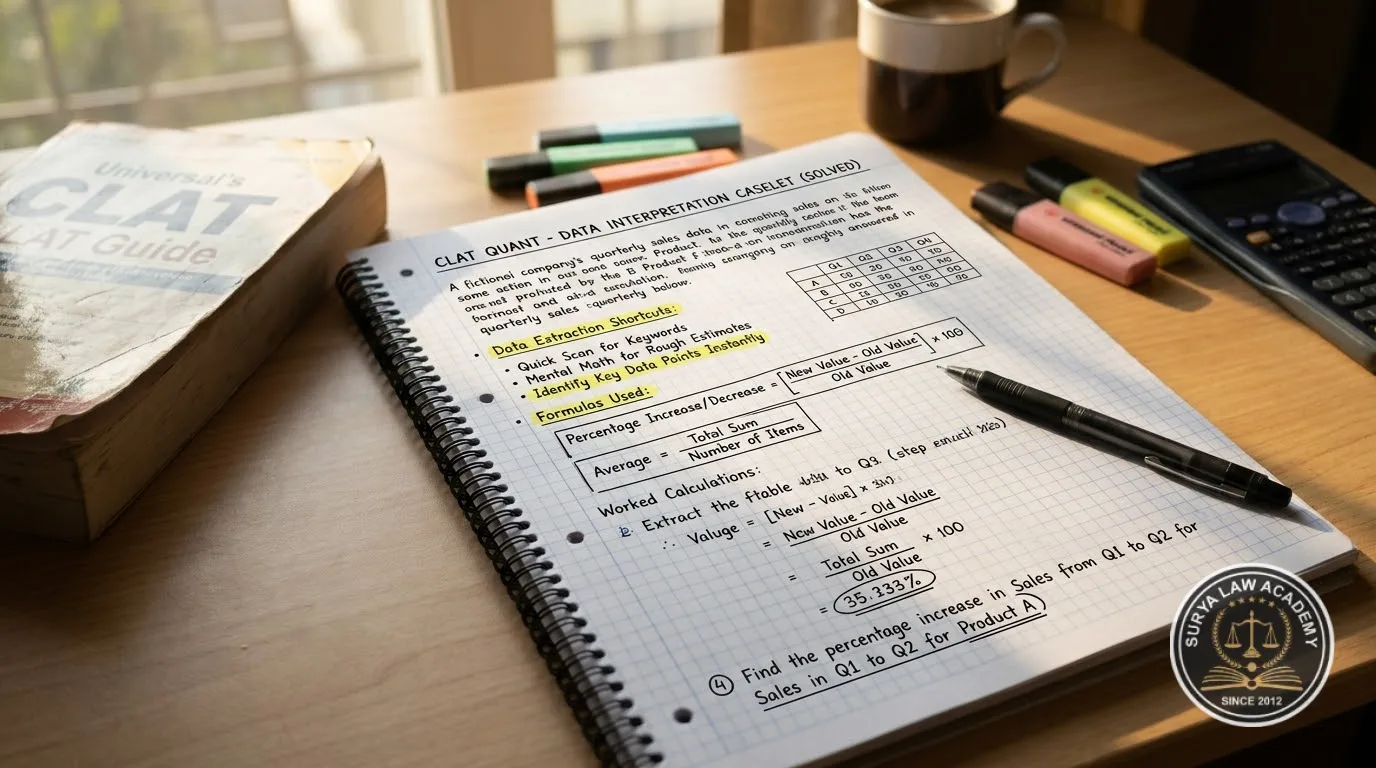
Step-by-Step Strategy to Solve Data Interpretation Caselets
Solving a passage-based caselet requires systematic reading rather than impulsive calculation. Candidates often make mistakes by jumping straight to questions before comprehending the context.
At Surya Law Academy, classroom mentoring emphasizes a structured four-stage extraction process designed to maintain computational accuracy under strict time constraints.
Read the narrative completely once to identify the primary entities and measured units.
Translate raw narrative details into a compact table, matrix, or bulleted summary.
Verify given constraints, ensuring that total values and category breakdowns balance correctly.
Answer the associated questions systematically using your organized tabular data.
Organizing your scratch sheet neatly reduces arithmetic slips and eliminates the need to reread long passages repeatedly.
The 20-Minute Daily Drill Routine for CLAT QT
Consistency outweighs occasional cramming when mastering quantitative caselets. Dedicating just twenty focused minutes each day can transform your comfort level across the entire section.
Surya Law Academy provides hardcopy study material and maintains batches of 15-25 students to ensure every learner receives individual problem-solving reviews during daily practice.
Minutes 0 to 5: Review mental arithmetic, table conversions, and ratio simplifications.
Minutes 5 to 15: Solve one full passage-based caselet under strict mock test conditions.
Minutes 15 to 20: Conduct an immediate error audit to evaluate misread data or arithmetic errors.
This brief daily habit builds speed, strengthens data extraction, and prevents computational fatigue during full-length practice sessions.
Avoiding Negative Marking and Refining Exam-Day Speed
Because CLAT imposes a -0.25 negative marking penalty for wrong answers, guessing on quantitative questions carries real risk. High-scoring candidates, such as Saransh Kumar (CLAT AIR 25) and Ananya Sharma (CLAT AIR 32), demonstrate that calculated question selection determines success in competitive exams.
With 200+ mock tests in CLAT batches at Surya Law Academy, students learn precisely when to invest time in a caselet and when to move forward.
Avoid spending extended minutes recalculating ambiguous data sets.
If a caselet relies on confusing initial values, mark it for review and proceed.
Keep your rough work clean and numbered to cross-check solutions without redoing entire calculations.
Treat the 10-14 QT questions as an essential contributor toward your overall institutional target.
🎯 Sharpen Your GK Right Now
Practice today's 10-question CLAT / PU Law daily current-affairs quiz with instant scoring and a live leaderboard.
📚 Download the Free Quantitative Techniques Prep Sheet
Get a free, printable one-page revision sheet sent straight to your WhatsApp. No spam, only study material.
🔒 100% private. Only study material — no spam calls.
Plan Your CLAT QT Preparation Preparation With an Expert
Join the batch that produced CLAT AIR 17 (NLSIU), AIR 32 (NLSIU) and PU UILS AIR 1 & 4. Small batches, direct mentor access, 200+ mocks.