


Cracking the Panjab University law entrance exam requires more than just reading textbooks; it demands a deep understanding of the exam's unique pattern. Located just 5 minutes from Panjab University in Sector 25-D, Chandigarh, Surya Law Academy has guided thousands of aspirants since 2012. Utilizing previous year papers strategically is your key to mastering the syllabus and securing a top rank in UILS Chandigarh.
💡 Mastering previous year papers through a systematic attempt-analyse-log loop helps you bridge the gap between passive reading and active exam execution.
Decoding the PU CET Law Question Pattern and Section Split
Before diving into past papers, you must understand the exact blueprint of the exam. According to the official prospectus, the paper consists of 100 objective questions to be solved in 90 minutes, featuring a negative marking of -0.25 per wrong answer.
Law Section: Carries 40 marks (Questions 1 to 40), focusing on fundamental legal concepts.
General Knowledge & Current Affairs: Carries 40 marks (Questions 41 to 80).
Reasoning & English: Split into 10 marks for Reasoning (Questions 81 to 90) and 10 marks for English (Questions 91 to 100).
Analyzing past papers reveals how these sections are structured, allowing you to allocate your 90 minutes efficiently across all 100 questions.
Step 1: The Timed Attempt Under Simulated Exam Conditions
The first phase of utilizing PU CET Law previous year papers is the simulated attempt. Treat every past paper as the actual examination. Sit in a quiet room, set a timer for exactly 90 minutes, and complete the paper in one sitting without referring to study material or answer keys.
Replicate exam-day pressure to build stamina for managing 100 questions.
Practice making calculated decisions regarding the -0.25 negative marking scheme.
Identify which sections cause you to spend excess time, enabling better pacing for future practice sessions.
This disciplined approach ensures that your brain adapts to the cognitive load required on the day of the test.
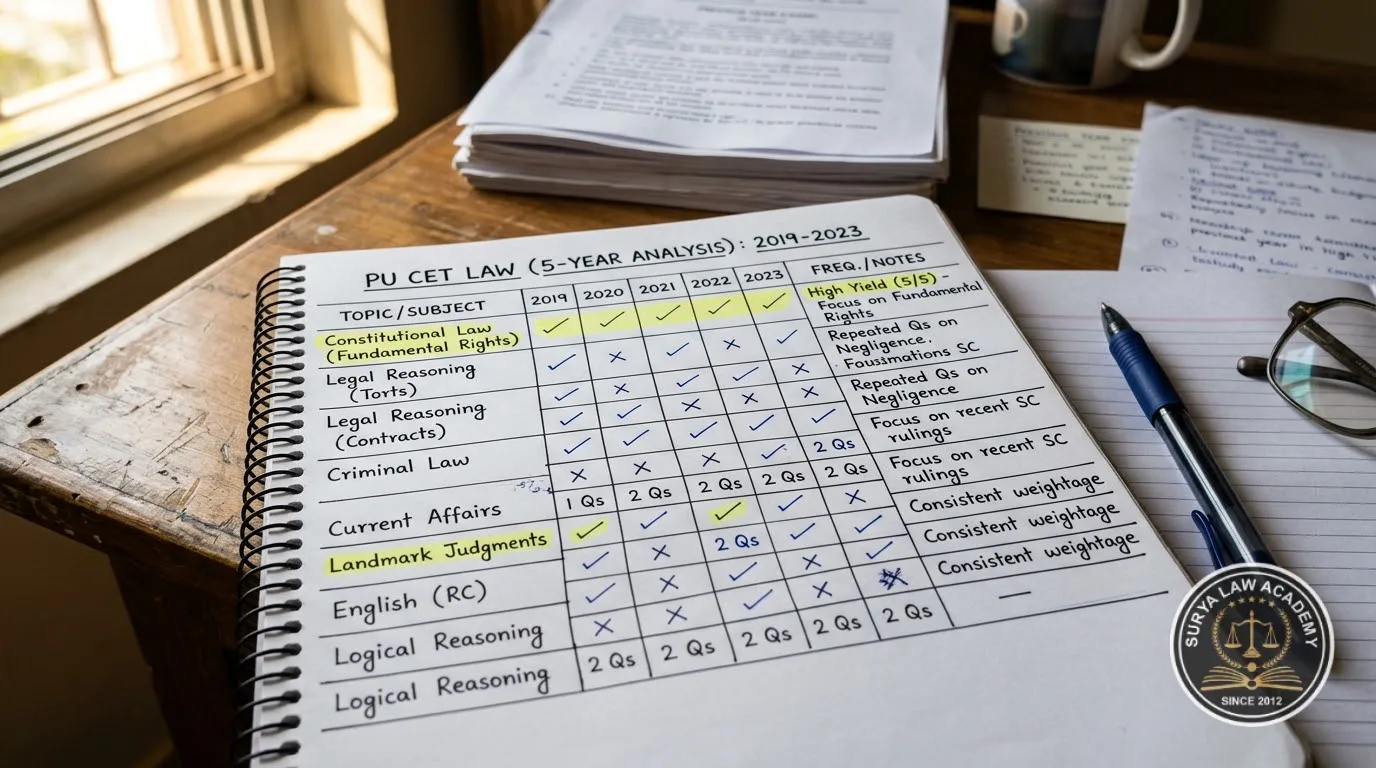
Step 2: The Deep-Dive Analysis Phase
Simply checking your final score after an attempt is a major mistake. The real learning happens during the analysis phase. Go through every single question you attempted, regardless of whether your answer was correct, incorrect, or left blank.
For correct answers, verify if your logic aligns with the intended legal or logical reasoning.
For incorrect answers, pinpoint the exact root cause—was it a factual gap in current affairs, a misinterpretation of a legal principle, or a silly calculation error?
For unattempted questions, study the underlying concepts to ensure you can tackle similar queries in the upcoming exam.
This meticulous review transforms a standard mock test into a powerful learning tool.
Step 3: Maintaining the Error Log and Revision Loop
The final step of the framework is creating and maintaining an error log. As you analyze multiple PU CET Law previous year papers, compile your mistakes, difficult legal concepts, and missed current affairs into a single notebook or digital document.
Review your error log weekly to ensure you do not repeat the same mistakes.
Revisit challenging legal principles and reasoning shortcuts regularly.
Pair your past paper practice with comprehensive study materials, such as the hardcopy notes and 200+ mock tests provided during structured coaching at Surya Law Academy.
By closing your knowledge gaps systematically, you steadily build the confidence needed to secure competitive scores like past toppers (such as Navneet Kaur with AIR 4 PU UILS or Bhavbhanjanjot Singh with AIR 7 PU UILS).
Optimising Your 50:50 Merit Score for UILS Chandigarh
A unique aspect of admission to Panjab University's Department of Laws and UILS is the merit calculation formula. The final merit score is determined by combining 50 percent of your PU CET Law score with 50 percent of your Class 12 marks.
High performance in the entrance exam alone is not enough; your Class 12 board marks play an equally critical role in your final standing.
Reference cutoffs from previous cycles show high competitiveness, with UILS Chandigarh closing around 74.7, PURC Ludhiana around 71.0, and PUSSGRC Hoshiarpur around 69.0.
To secure admission into your preferred campus, balance your entrance exam preparation using past papers while maintaining strong academic foundations.
🎯 Sharpen Your GK Right Now
Practice today's 10-question CLAT / PU Law daily current-affairs quiz with instant scoring and a live leaderboard.
📚 Download the Free PU Strategy Prep Sheet
Get a free, printable one-page revision sheet sent straight to your WhatsApp. No spam, only study material.
🔒 100% private. Only study material — no spam calls.
Plan Your PU CET Law Strategy Preparation With an Expert
Join the batch that produced CLAT AIR 17 (NLSIU), AIR 32 (NLSIU) and PU UILS AIR 1 & 4. Small batches, direct mentor access, 200+ mocks.